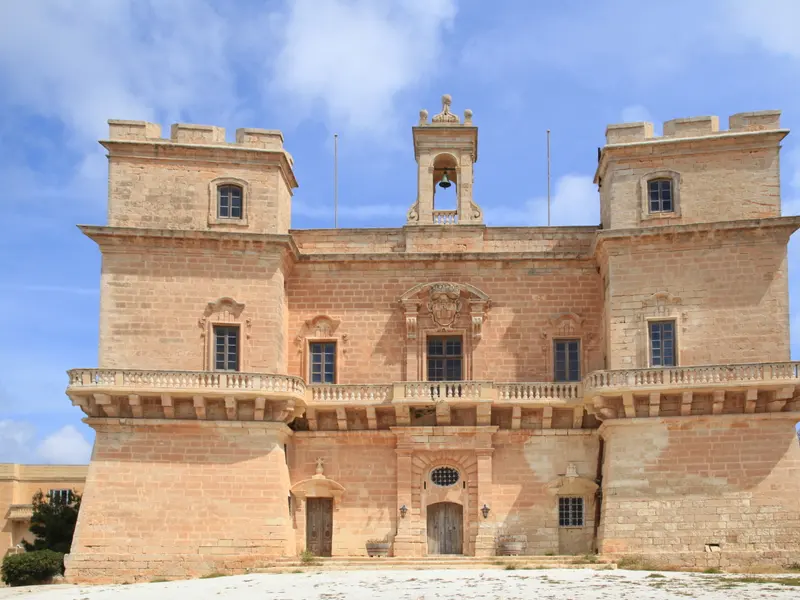
Selmun Palace is a Baroque countryside villa on the Selmun Peninsula above Mellieħa, a grand house whose square plan and rooftop bell-cot make it look like a small fortress in the landscape. You visit for a short look at the exterior from Selmun Road, then fold it into a northern Malta day of views and bays.
Who gets the most from it. Architecture lovers and history-minded travellers will enjoy the details and the story behind the building, photographers will like the way the afternoon sun pulls the mouldings out of the limestone, and anyone touring Mellieħa will find it a natural stop between beaches and viewpoints. If you want a fully staffed attraction with exhibits and regular interior tours, this is not that: it is a protected historic villa in need of restoration, so most people admire it from outside and move on.
The backstory is very Maltese. The lands were left in 1619 by Caterina Vitale to the charitable Monte della Redenzione degli Schiavi, the organisation set up to ransom Maltese captives, and the villa you see was completed in the 18th century in a style that nodded to Verdala and the Wignacourt towers. It was rented to Knights of the Order of Saint John for relaxation and rabbit hunting, with the income feeding the redemption fund. It served as the first naval hospital in Malta during the Maltese rebellion against the French, a reminder that grand country houses were pressed into service when needed. A semaphore was installed in the 1840s, and the earliest cartographic mention is on an Italian map of 1783 that labels it Torre Nuova, which explains why some locals still call it Selmun Tower.
Look closely at the architecture and the trick becomes clear. Selmun Palace looks fortified from a distance, but it was not intended for military use. The plan is a tight square articulated by four pseudo‑bastions and corner turrets with mock embrasures, a theatrical skin meant to deter corsairs looking up from the coast rather than to resist cannon. The main façade has three ground-floor doors with the middle one larger and framed by a decorative portal. The right-hand ground floor door once served the palace chapel. The left door was later blocked and turned into a window, a detail you can still pick out in the stonework. Above, five first-floor doors open to a continuous balcony that runs around the perimeter, and the Monte di Redenzione coat of arms is carved above the middle balcony door. A small bell sits in the middle of the façade and a neat bell‑cot caps the roof, more signals of status and piety than functional military kit. Built in local limestone, it is a textbook piece of rural Baroque given a martial costume.
Faith and patronage are woven into the site. The palace chapel is dedicated to Our Lady of Ransom, the same patron as the redemption charity that commissioned the house, and a new chapel with the same dedication was built outside the villa in the 1980s. The titular painting by Antoine Favray is kept in a small chapel near the palace, so even if the villa itself is closed you can trace the religious thread that justified the estate.
The setting is as strong as the stonework. The villa stands above Mistra Valley and looks over the folds of the Selmun Peninsula, a quiet corner of Mellieħa with fields, thyme and carob trees. The estate includes Mistra Gate, a dignified entrance feature to the lands, and Mistra Gate was restored a few years ago. Today the owner is the Government of Malta and the building is a Grade 1 national monument, scheduled on 10 January 2012, which explains why it is intact but not reworked as a modern museum.
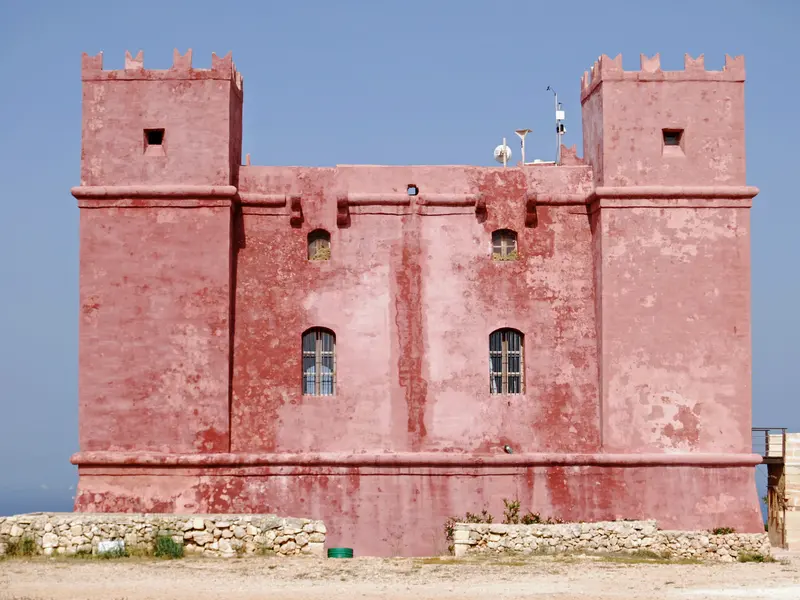
Getting there is simple if you are already exploring the north. Selmun Road runs right to the house from Mellieħa, so a quick hop by car or taxi is the easy option, and it fits neatly between a swim at Mellieħa Bay and a sunset at the Red Tower Mellieħa. Walkers can also make a pleasant loop that takes in the palace, the valley and nearby coves, then descend to quieter shores such as Imgiebah Bay or the dramatic Coral Lagoon. If you prefer film-set colour, pair it with the Popeye Village viewpoint or a birding hour at the Għadira Nature Reserve.
There is no ticket office to fuss with here. Interior access has been occasional and event-based: the villa has been used as a wedding venue and, when the adjacent Selmun Palace Hotel was operating, some suites were arranged in the building. For a casual visitor, plan on an exterior visit and photographs rather than rooms and displays.
Accessibility depends on what you want to do. The approach is on a rural road with some uneven patches on the verge, but you can view the façades from level ground without committing to a hike. The immediate surroundings are exposed and can be windy, so plan shade and water rather than relying on facilities.
Parking is straightforward for drivers. Selmun Road has space to pull in near the palace, and there is a parking zone by the former hotel complex next door. As with all countryside stops in Malta, do not block field gates or tracks.
Family-wise, this is a short stop rather than a destination. Children who like castles will enjoy the make‑believe battlements, but there are no exhibits or play areas, and the weather decides how long you linger. Keep toddlers close by the road edges and steps, and bring hats and water in the warmer months.
What to bring is simple: comfortable shoes for gravel and stone, water and a hat in summer, and a camera if you like architectural details. The façade rewards a longer lens for mouldings and coats of arms, while a wider one helps catch the square mass in its landscape.
What people get wrong about Selmun Palace is thinking they will tour a fortress or a furnished state residence. It is neither. It is a country villa that borrowed the language of fortification to project authority and safety, part theatre, part charity asset, with a life that has ranged from noble leisure and rabbit hunts to hospital and semaphore post.
Common questions
Is Selmun Palace a fortress?
No. Selmun Palace looks fortified from a distance, but it was not intended for military use. The corner turrets and embrasures are largely decorative and were meant to signal strength rather than to fight a battle.
Can you go inside Selmun Palace?
Interior access is not routinely available. The villa has been used for weddings and, when the adjacent hotel was operating, some suites, so access can be event-based rather than a set public opening.
Who built Selmun Palace and when?
It is an 18th‑century Baroque villa attributed to Domenico Cachia, built for the Monte della Redenzione degli Schiavi, the charity that ransomed Maltese captives.
What is the chapel linked to the palace?
The palace chapel is dedicated to Our Lady of Ransom. A new chapel with the same dedication was built outside the villa in the 1980s, and the titular painting by Antoine Favray is kept in a small chapel near the palace.
Where is it and how do I get there?
Selmun Palace stands on Selmun Road on the Selmun Peninsula above Mellieħa. It is easiest by car or taxi for a quick stop, with roadside parking by the approach. You can also fold it into a longer walk around Mellieħa and Mistra Valley.
Last checked: 9 November 2026. Prices, opening hours and timetables change, verify anything time-sensitive before you travel. Photo: Frank Vincentz, CC BY-SA 3.0.