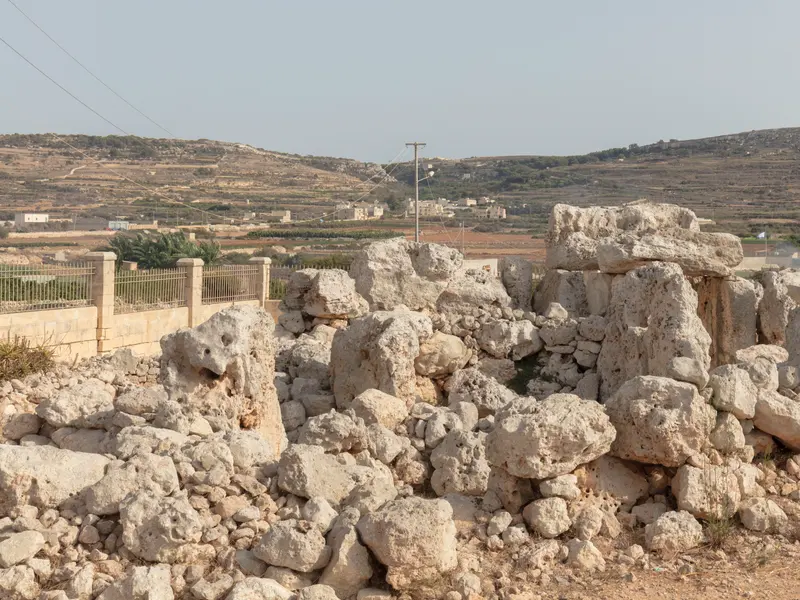
Ta’ Ħaġrat is a pair of small prehistoric temples on the edge of Mġarr, amongst the world's oldest religious sites. You come for a quiet, readable site in a village setting, part of the Megalithic Temples of Malta recognised by UNESCO in 1992, rather than for towering stones.
It suits travellers who like to stand in a space and understand how it worked. The chambers are easy to read at ground level, and the site is rarely busy. If you want scale and sea views, keep Ħaġar Qim and Mnajdra for another day and come here for clarity. The doorway appears on Mġarr’s local council emblem, a hint of how closely the village identifies with the place, and Ta’ Skorba temples are about 1 km away, so pairing them makes sense.
Where it is and how to get there: the temples stand on the eastern outskirts of Mġarr, on a quiet lane a short walk from the parish square. The nearest bus stop is a 5 minute walk. If you are driving, you can fold it into a north-west loop that might also take in Gnejna Bay, Popeye Village or Golden Bay & Għajn Tuffieħa.
Opening arrangements can change, so check the Heritage Malta page before you go. UNESCO World Heritage inscription year is 1992.
Tickets and prices are straightforward. Adult admission is €3.50 (18+). Youth 12–17 pay €3.00. Seniors 60+ pay €3.00. Students pay €3.00. Children 6–11 pay €2.50. Infants 1–5 are free. Heritage Malta members are free. Heritage Malta Passport holders are free. Tickets are not sold on site. Tickets are sold by local cafes, shops and the local council in Mġarr. Combo tickets for Skorba & Ta’ Ħaġrat are available online.
If you are buying in the village, these outlets currently handle sales and will stamp you in when you arrive. Opening hours are short and vary by day, so plan around them rather than the other way round:
- Il-Barri (Tue-Fri 10.30-14.30; Sat 09.00-15.00; Sun 11.30-15.00)
- Il-Gastronawt (Tue-Fri 08.00-17.30; Sat 09.00-16.00; Sun 09.00-13.00)
- Mġarr Farmers Bar (Mon-Sun 06.00-17.30)
- Mġarr Local Council (Mon-Fri 08.00-12.00; Sat 08.00-11.00)
What the site feels like: two adjacent temples sit side by side, each laid out in a trefoil plan with three semi-circular chambers off a central space. A concave façade and semicircular forecourt frame the entrance. You come in through a narrow corridor flanked by upright coralline megaliths, then into a central court where the surface is laid in torba, a hard, cement-like floor. The apses have roughly hewn stone walls and a rock floor. At Ta’ Ħaġrat two steps lead up to the doorway, an uncommon feature in Malta’s temple sites.
The smaller structure mirrors the plan but with smaller stones. The smaller structure abuts the northern side of the major temple, and later work even modified the eastern room of the main building to make space for it. There are no carved frills here: No decorated blocks have been found at Ta’ Ħaġrat, which helps you focus on the architecture and how it was put together.
Archaeology and history in brief. The site was discovered in 1917. Excavations took place in 1923, 1925, 1926, 1953 and 1961, with the first campaigns led by Sir Temi Zammit. Restoration took place in 1937, when Carmelo Abela was tasked with filling vertical gaps in the megaliths to stabilise the walls, and the village turned out to help. Lemonade was distributed at a community event during restoration.
Finds and what they mean: Artifacts were first kept at Mġarr primary school, then moved to the National Museum of Archaeology. A small globigerina limestone model was found here. It shows a trilithon doorway and horizontal corbelling, which many take as a clue that parts of the original buildings were covered. The scale model was roofed. Ceramics from earlier and later periods were found, showing long use of the spot, and the temples themselves were in use for hundreds of years. Ta’ Ħaġrat is considered among the earliest free-standing structures, and it is considered a milestone in technological evolution on the islands.
Timeline and context: activity here reaches back to around 3800 BC, with the settlement pottery known as the Mġarr phase predating the main buildings. The larger temple belongs to the Ġgantija phase, around 3600–3200 BC, and the smaller to the Saflieni phase, roughly 3300–3000 BC. Before excavation it appeared as a circular mound topped by a large carob tree, and in later years carob roots crowded stones so much that carob trees caused horizontal elements to topple. It has been consolidated and is managed today by Heritage Malta.
What to look for when you are there. Start outside to take in the concave front and semicircular forecourt, then walk the entrance corridor and stop on the two low steps to see how the plan opens to left and right. Look for the rough coralline blocks that form the door jambs, the torba floor of the central court and the way the minor temple tucks neatly against the north side of the larger one. The point of Ta’ Ħaġrat is clarity and texture rather than carved ornament.
Make a day of it in the north-west: swim or walk after your visit at Gnejna Bay or Golden Bay & Għajn Tuffieħa, or detour to the film set at Popeye Village and the Anchor Bay viewpoint. If prehistory is your thread, keep going down the coast to the Xemxija Heritage Trail for rock-cut tombs and cart-ruts above St Paul’s Bay.
Common questions
Is this a good first temple site if I have limited time?
Yes if you want something quiet and readable in a village setting. If you want dramatic sea-cliff views and larger stones, go for Ħaġar Qim and Mnajdra instead, then come here for context when you have more time.
Can I combine it with another site nearby?
Yes. Ta’ Skorba temples are about 1 km away, and there is a combined ticket. If you are making a north-west day, add a swim at Għajn Tuffieħa & Golden Bay or a look at Popeye Village.
How long do I need on site?
Most visits are short, enough to walk the plan, read the panels and take photos. If you add Skorba and a coffee in Mġarr square, it becomes a relaxed half-day.
Last checked: 11 November 2026. Prices, opening hours and timetables change, verify anything time-sensitive before you travel. Photo: Diego Delso, CC BY-SA 4.0.